
Tax Season Organization: Why a Clean Home Helps You Think Clearly
The rain is tapping against the windows, the days are short, and if you’re like most Portlanders, you’ve spent the last few months hibernating in cozy comfort. But as we turn the calendar from February to March, a different kind of weather pattern moves in: Tax Season.
For many of us, the mere thought of gathering receipts, tracking down charitable donations, and organizing financial documents induces a wave of anxiety. We often blame the complexity of the tax code or our busy schedules, but what if the root of the problem is actually surrounding you right now? What if the reason you can’t find your W-2 or focus on line 17a is because of the visual chaos in your physical space?
There’s a powerful connection between the state of your home and the clarity of your mind. This tax season, before you dive into the spreadsheets, it might be time to tackle the clutter. A strategic approach to Portland home cleaning isn’t just about aesthetics, it’s about resetting your cognitive bandwidth so you can actually think clearly, save money, and file with confidence.

The Science of Visual Clutter and Mental Load
We’ve all heard the phrase “tidy house, tidy mind,” but this isn’t just a catchy saying; it’s neuroscience. Princeton University neuroscientist Sabine Kastner has spent years researching how the brain processes visual information. Her findings are startling: visual clutter competes with your brain’s ability to pay attention. When your visual field is filled with objects (piles of mail, last season’s coats, random gadgets), your brain has to work overtime to filter them out. Over time, this constant “neural push and pull” tires out your cognitive functions, reducing your ability to process information and focus .
Think of your attention as a spotlight. In a cluttered room, that spotlight is flickering, trying to illuminate everything at once. In a clean, organized space, that beam is steady and strong, allowing you to concentrate on the task at hand like reconciling your bank statements.
This is particularly relevant during tax season, a time that demands high-level cognitive function, attention to detail, and patience. By investing in home organization Portland residents trust, you are essentially upgrading your mental hardware. You are removing the “visual noise” that distracts your brain, freeing up precious mental energy to ensure you don’t miss that crucial deduction .
The Winter Dust Dilemma: More Than Just Dirt
Here in the Pacific Northwest, winter is a double-edged sword. It’s beautiful and cozy, but it also means our homes have been sealed up tight since October. We’ve been running the heater, burning candles, and tracking in moisture from the relentless rain. This creates the perfect storm for two specific enemies of tax preparation: dust and paper accumulation.
The Dust Factor:
Over the winter, dust doesn’t just settle on your surfaces; it settles on your electronics, your keyboard, and your paperwork. Dust can actually damage sensitive electronics and, more importantly, it contributes to a feeling of stagnation. When you sit down at a dusty desk to tackle your taxes, the environment feels heavy and neglected, which subconsciously signals to your brain that this task is also going to be heavy and neglected.
Furthermore, dust buildup in vents and on baseboards can circulate allergens, making you feel lethargic and “foggy-headed.” A deep Portland home cleaning that focuses on these winter-specific grime accumulations can instantly make a room feel lighter and more breathable .
The Paper Problem:
Winter is also the season of “piling.” We come in from the cold, drop the mail on the counter, and let it stack up because it’s too rainy to take the recycling out. Receipts get stuffed in junk drawers. Important tax documents get buried under catalogs. This physical paper clutter is a direct reflection of mental clutter. It represents unfinished business, and seeing that pile every day creates low-grade, chronic stress.
Resetting the Command Center: Your Home Office
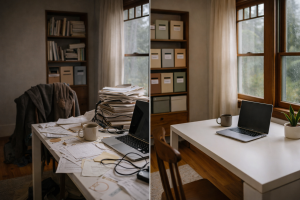 For most of us, tax preparation happens in a home office or at the kitchen table. If you’re planning to tackle your finances, the very first step isn’t pulling up last year’s return—it’s cleaning your workspace.
A study on office cleaning highlights that a tidy desk isn’t just a luxury; it’s a productivity tool. A clean workspace can reduce stress and make you less likely to procrastinate. Conversely, a dirty keyboard or a smudged screen can harbor germs and create a subconscious feeling of unease .
Here is a quick “Tax Season Workspace Reset” guide to get you started:
1. The 10-Minute Surface Blitz:
Clear everything off your desk. Yes, everything. As you place items aside, sort them into three piles: “Tax/Finance,” “To File,” and “Trash/Shred.” Use a microfiber cloth and an all-purpose cleaner to wipe down every surface. Don’t forget to clean your monitor with a screen-safe solution and disinfect your keyboard and mouse these are germ magnets that you’ll be touching for hours .
2. Tame the Cable Chaos:
Nothing says “mental chaos” like a nest of tangled cables. Unplug everything, use zip ties or Velcro straps to bundle cords, and label them if necessary. A clean cable setup visually organizes the space and makes it easier to access your devices.
3. Go Vertical with Storage:
If papers are covering your floor, you don’t have a mess; you have a storage problem. Invest in vertical filing systems. Use wall-mounted shelves or clear, labeled bins to keep documents off the floor and desks. This aligns perfectly with home organization Portland principles—making the most of your space to create flow and function .
Room-by-Room: The Hidden Tax Clutter
While the home office is the obvious ground zero for tax prep, clutter in other rooms can contribute to your overall mental load, making it harder to relax and, in turn, harder to focus when it’s time to work.
-
The Entryway: Winter entryways are graveyards for wet boots, coats, and you guessed it, more mail. If your entryway is chaotic, you’re carrying that stress into the house with you every evening. Professional organizers suggest creating a “staging area” near the door for items you need to take with you (like that donation receipt you need to drop off), which prevents piles from forming .
-
The Kitchen: The kitchen island or counter often becomes the default “landing strip” for the day’s mail and school papers. This visual clutter is distracting, especially if your kitchen is open to your living or working area. Make it a rule: the kitchen is for eating and food prep only. Papers must be moved to the office within 24 hours.
-
The Bedroom: Sleep quality is directly linked to cognitive function. If your bedroom is cluttered with laundry, books, and random items, your brain remains slightly alert, preventing deep, restorative sleep. A calm bedroom means a calmer mind in the morning, ready to tackle complex financial tasks.
The Link Between a Clean Home and Financial Clarity
Here is where we touch on the subtle connection to your world, the world of bookkeeping.
Bookkeeping and professional organizing share a core philosophy: categorization and consistency. A professional organizer looks at a cluttered room and sees a lack of “homes” for items. A bookkeeper looks at a disorganized shoebox of receipts and sees a lack of financial “homes” for transactions.
When your home is clean and organized, you are practicing the physical version of what a bookkeeper does digitally. You are:
-
Categorizing: (Mail goes here, books go there).
-
Reconciling: (Making sure what you have matches the space you have).
-
Auditing: (Getting rid of what doesn’t serve you, like expired products or unnecessary papers).
When you live in a space that has been cleaned and organized, you naturally start to apply those same logical principles to your finances. It becomes easier to imagine setting up a chart of accounts when your actual environment is already set up for success. You realize that just as you need a Portland home cleaning to reset your physical space, you might need a “financial cleaning” to reset your monetary health.
Practical Tips: Spring Cleaning for Tax Season
You don’t need to renovate your entire house to benefit from these effects. Sometimes, a focused effort on key areas can unlock the mental clarity you need. Here are some actionable steps to bridge the gap between home organization Portland style and tax prep:
1. The “One-Touch” Rule for Mail:
When you bring in the mail, sort it immediately next to the recycling bin. Junk mail goes straight in the trash. Bills go in a standing file holder (not a pile). Catalogs go in a designated “reading” spot. Never put a piece of mail down with the intention to “deal with it later.” Later is now, and later is why we have piles.
2. Create a “Tax Zone”:
You don’t need a whole office; you just need a zone. Find a plastic caddy or a decorative box. Label it “Tax Year 2025.” Every time you find a relevant receipt, a charitable donation slip, or a medical expense statement from January through March, put it directly in the box. When tax day arrives, your documents aren’t scattered around the house; they’re in one, clean, consolidated zone.
3. Shred and Purge:
Winter accumulation often includes documents we should have shredded months ago. Spend 15 minutes going through old bank statements and pay stubs from previous years (that you no longer need for legal purposes). Feed them to the shredder. The physical act of destroying old paper is incredibly cathartic and makes room for the new, organized system you’re building.
4. Call in the Pros:
Sometimes, the mental load is just too heavy. If you look around your home and feel paralyzed by where to start, it might be time for reinforcements. A professional Portland home cleaning service can handle the deep cleaning the baseboards, the windows, the behind-the-furniture dust that you don’t have the energy for . Coming home to a professionally deep-cleaned house provides a blank slate, making the task of organization feel possible rather than overwhelming. Services like Rise and Shine Cleaning Service emphasize that a clean home creates calm, especially during busy seasons .
Conclusion: Breathe In, File On
Tax season doesn’t have to be a period of dread and chaos. By understanding the deep connection between your environment and your cognition, you can turn your home into an ally rather than an obstacle.
Clearing the visual clutter from winter, deep cleaning the dust from your workspace, and creating dedicated homes for your financial documents are acts of self-care. They are the physical manifestations of a desire for order and clarity. And as you sit down to file your taxes, in a clean, quiet, organized space, you might just find that the numbers make a little more sense, the stress feels a little more manageable, and your mind is finally clear enough to think.
After all, a clear home doesn’t just look good it helps you think straight. And when it comes to your finances, clear thinking is the best asset you have.